
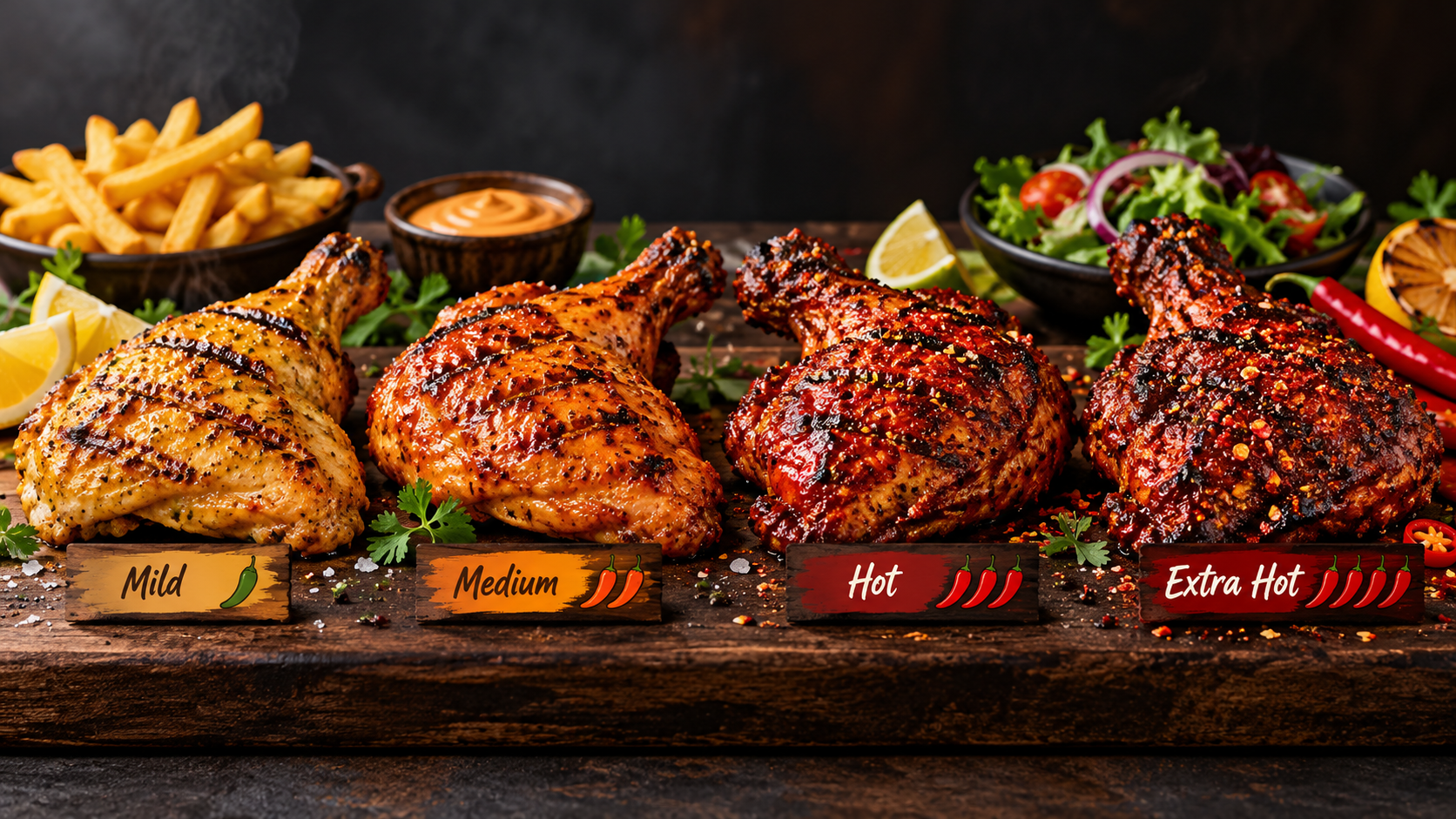
Deciding on peri-peri chicken can get tricky when you have to answer the question ‘how spicy do you want it?’ There are options like mild, medium, hot or extra hot. For first timers peri-peri can get a bit tricky.
Some prefer a slight warmth from chilis while some prefer a kick from a spicy meal. But peri-peri spice levels not just change with the amount of heat a sauce carries, but also the amount of flavor. Sometimes a mild peri-peri spice level can be more palatable than the hot levels.
So how spicy is peri-peri chicken and which level should you pick?
Below are all the levels, what to expect from them and how to pick the one which suits you.
What are the Different Levels of Peri-Peri Spice?
While indicating the spice level of sauces, the wording is more or less the same. The differences begin with the universal standard.
We are used to seeing 4 major levels – mild, medium, hot and extra hot. Some places may add a level before the mild like extra-mild. The extra-mild may not always be there but flavored peri-peri sauces like lemon and herb are.
The main idea is to have something for the person who doesn’t prefer spicy food, and for the person who likes to experience a chilly kick.
But there’s a thing to keep in mind. There is no universal standard for peri-peri.
Since different restaurants use different types and amounts of chili in their marinades, one restaurant’s medium sauce could feel very different from another’s. The other ingredients in the marinade can also affect how it feels on your tongue. This is why understanding each level of spice generally can be helpful.
Peri-Peri Spice Level Chart: Mild to Extra Hot
This chart helps clarify what to expect when ordering different spice levels of peri-peri chicken.
| Spice level | Heat intensity | Flavour experience | Best suited for |
| Mild | Low | Tangy and garlic with very mild warmness | Perfect if you want to try the flavour but don’t like a lot of heat |
| Medium | Moderate | Some seasoning and a slight kick of chilli | If you don’t mind a little bit of heat and are looking for a balance |
| Hot | High | Chilli seasoning with a good kick and a mildly lingering heat | Typical spicy food lover |
| Extra Hot | Very high | Very strong chilli heat that overpowers the other ingredients | Extreme spicy food lover |
These general descriptions are based on many different sources. Each restaurant’s sauces can vary a lot. Also, extra hot doesn’t always mean it tastes the best. Sometimes the balance of flavour and heat is better in the medium sauces, based on your personal preference.
What is the Spiciness of Each Peri-Peri Flavor?
Finally, what do each of the levels actually feel and taste like?
Mild Peri-Peri: Is It Actually Spicy?
Mild Peri-Peri is a good starting point if you want to try the flavor of peri-peri but don’t like a lot of heat.
Even though there isn’t a lot of heat compared to the hotter sauces, mild peri-peri still has some spice. Garlic, lemon and other spices are usually more prominent with less heat.
Because of the seasoning, mild peri-peri is a good choice for people who generally avoid spicy foods, but still want well seasoned chicken.
Depending on the recipe, you may not even notice the heat after a couple of bites, but be sure to check what the restaurant means by mild if you have a low spice tolerance.
Medium Peri-Peri
Medium peri-peri usually strikes a good balance of a bit of a chilli kick and more gentle warmth.
This makes it a good choice for people who prefer more spicy food. However, if a dish is mostly spicy, other flavours won’t be as pronounced. With a medium peri-peri, garlic, citrus and herbs can be tasted as well.
For someone who has tried mild peri-peri and was used to less heat, medium is a good step up.
Depending on your tolerance for heat, you may think the same for hot peri-peri.
Hot Peri-Peri
Hot peri-peri makes the chilli the focal point of the dish.
Generally the heat is noticeable after the first few bites and amplifies with each successive bite. You may still get the taste of the garlicky and tangy marinade but the chillies take center stage.
It definitely appeals to those who regularly consume spicy foods.
Just because you’re accustomed to one type of spicy food, doesn’t mean every hot peri-peri sauce is the same.
Like all foods with a spicy kick, the heat level is dictated by the type of chillies used to make the sauce. The amount of peri-peri sauce used also comes into play.
If you like a lingering, noticeable spicy kick with your grilled chicken then hot peri-peri sauce is something you may want to try.
How Much Heat Can You Expect From Extra Hot Peri-Peri?
Generally speaking, anyone who enjoys food with a kick is going to want to try extra hot. For the peri-peri chicken enthusiast, expect a heavy, lingering heat that amplifies with each bite.
For newcomers to the world of peri-peri chicken, jumping in with an extra hot sauce may prove to be an unpleasant experience.
It’s worth noting that there’s nothing wrong with simply preferring the milder sauces.
What Types Of Chillies Are In Peri-Peri Chicken?
The heat in peri-peri is predominantly from bird’s eye chillies. A type of chilli that packs a significant punch. The heat level can also be dictated by the amount of sauce used in the marinade.
The African bird’s eye chilli is probably the most well-known chilli associated with peri-peri. Bird’s eye chillies are small but have a large amount of capsaicin, meaning that they pack a lot of heat.
The burn associated with spicy food is a result of the chemical compound capsaicin, which is present in all peppers.
There are two main factors that contribute to how hot a sauce is.
– The first is the type of chilli pepper used, and the second is the concentration of chilli peppers in the sauce.
Of course, the chilli is not working alone.
A peri-peri sauce contains other ingredients such as lemon juice, vinegar, garlic and herbs and spices. These ingredients also play a role in how the heat is experienced.
As an example, a sauce which is high in garlic might be heavier and richer, while a sauce high in lemon juice would be sharper and more tangy.
There are also chilli recipes which include multiple varieties of chillis to create a complex flavour.
Mild, medium, hot and extra hot peri-peri sauces don’t necessarily have standard Scoville ratings.
This means that without a sauce being tested, the heat level associated with the name cannot be accurately determined.
How to Choose the Right Peri-Peri Spice Level
Choosing the right peri-peri heat level is not about how impressive it sounds; you’ll enjoy your meal a lot more if you choose a spice level that works for you.
Think about the kinds of spicy foods you typically like to eat.
- If you have never had peri-peri chicken before, the safest heat level to start with is mild.
- It’s a good way to sample the sauce’s garlicky and vinegary flavors and see if you like the seasoning before taking on the strong pepper kick.
- You can also try a medium Peri-Peri sauce if you have a higher tolerance for spicy foods.
- You can ask for an extra mild or non-spicy sauce if small amounts of pepper bother you.
Mild vs. Medium Peri-Peri Sauce: What’s the Difference?
The main difference between the two Peri-Peri sauces is the strength of the pepper heat.
- Mild Peri-Peri emphasizes the garlic and vinegar more.
- Medium Peri-Peri brings in more of a pepper and warm sensation.
For each sauce, the restaurants can use different blends to bring in different flavors.
If you’ve always gotten mild, and want it to have a bit more heat, going with the medium would be the better choice.
Hot vs. Extra Hot
You may be used to hot sauces, so going with the hot Peri-Peri may not be too bad.
Going with the extra hot may bring in too much of an unknown.
Extra hot may also be too much for your system if you’re not used to it.
A good rule of thumb is to consider other foods you may have that are equally as spicy, or a heavier portion size.
You always want to be able to enjoy the seasoning as well as the chicken.
Does a Higher Spice Level Change the Flavor?
Yes, but maybe not in a way people expect.
Higher spice levels can definitely change the level of heat the sauce brings.
You can’t just add more chilli and expect your food to become more flavorful. In this case, more doesn’t necessarily mean better.
Peri-peri sauce gets its name and character from a collaboration of various ingredients. The main player, of course, is the chilli, which brings the heat. But then you have the garlic, which provides depth to the sauce, and the lemon or vinegar, which adds that sharp edge to the peri-peri.
When these aspects come together, then you are able to derive more than just the heat.
Now, depending on how hot the sauce is, the heat may be the dominant factor. This can, of course, be the case if you are not accustomed to strong hot sauces.
A milder version can ease the appreciation of the other ingredients, which may include garlic, herbs and citrus.
On the other end of the spectrum, a strong hot sauce can be appealing to someone who is used to, and prefers, a stronger chilli heat.
Neither preference is wrong, it is just a matter of preference.
The ideal peri-peri spice level is just the one that appeases your taste.
Enjoy Peri Peri Chicken at Olives Peri Peri in Wallington!
Having a basic knowledge on peri-peri levels should help you next time you visit the restaurant for your chicken fix.
Olives Peri Peri has a range of other foods including pizzas, burgers, and wraps. You can visit their location, or order via the Uber Eats or Just Eats apps. Check the current menus to see what is available!
Peri-Peri Spice Levels FAQs
Is there any chilli in mild Peri-Peri?
Not necessarily. The heat in mild Peri-Peri comes from chillies in lower quantities or varieties. To be certain, it is always best to ask about the ingredients, or choose a non-spicy option.
Is medium Peri-Peri too spicy for beginners?
Maybe, but it isn’t always the case. Your tolerance for spicy food determines whether you can handle medium Peri-Peri. If you like chilli and are trying spicy chicken for the first time, opt for mild Peri-Peri.
Are the extra-hot Peri-Peri sauces the same across different restaurants?
No, they are not. Different restaurants use different ingredients to make their peri-peri sauces, and so, the heat levels can really vary. There is no standard for how spicy extra hot sauces need to be.
Does peri-peri chicken always come with spice?
No. Some restaurants have extra-mild and plain/non-spicy chicken options. It is always best to check the menu to be certain.
Do the ingredients in peri-peri sauces lose moisture when cooked?
Yes. Moisture loss leads to ingredient concentration. This change can make the spice in a sauce seem hotter. The final heat really depends on the chillies used and the quantities.
What can you eat with spicy peri-peri chicken to balance the heat?
Rice, bread, salad, and mild side dishes are good accompaniments to spicy meals. Cool yoghurt dips can be used to alleviate the burning sensation. If you find a sauce too hot, usually choosing the next level down the spice scale would be a good idea.
Olives Peri Peri
With peri-peri chicken, you have the option of varying the spice level from mild to extra hot. This gives you the flexibility to enjoy the same type of chicken with different levels of chilli heat.
Mild peri-peri is not very hot and is good for children, while medium peri-peri is good for the average adult. For a person who likes strong spices, the hot and extra hot level may be enjoyable.
Always remember there is a lot going on with peri-peri chicken. There are the flavors of citrus, garlic and herbs, and the grilling also adds a lot to the final product.
If you are not sure about how you will like it, try starting with mild, but do not be afraid to try one of the hotter levels next time if you want to try something new.